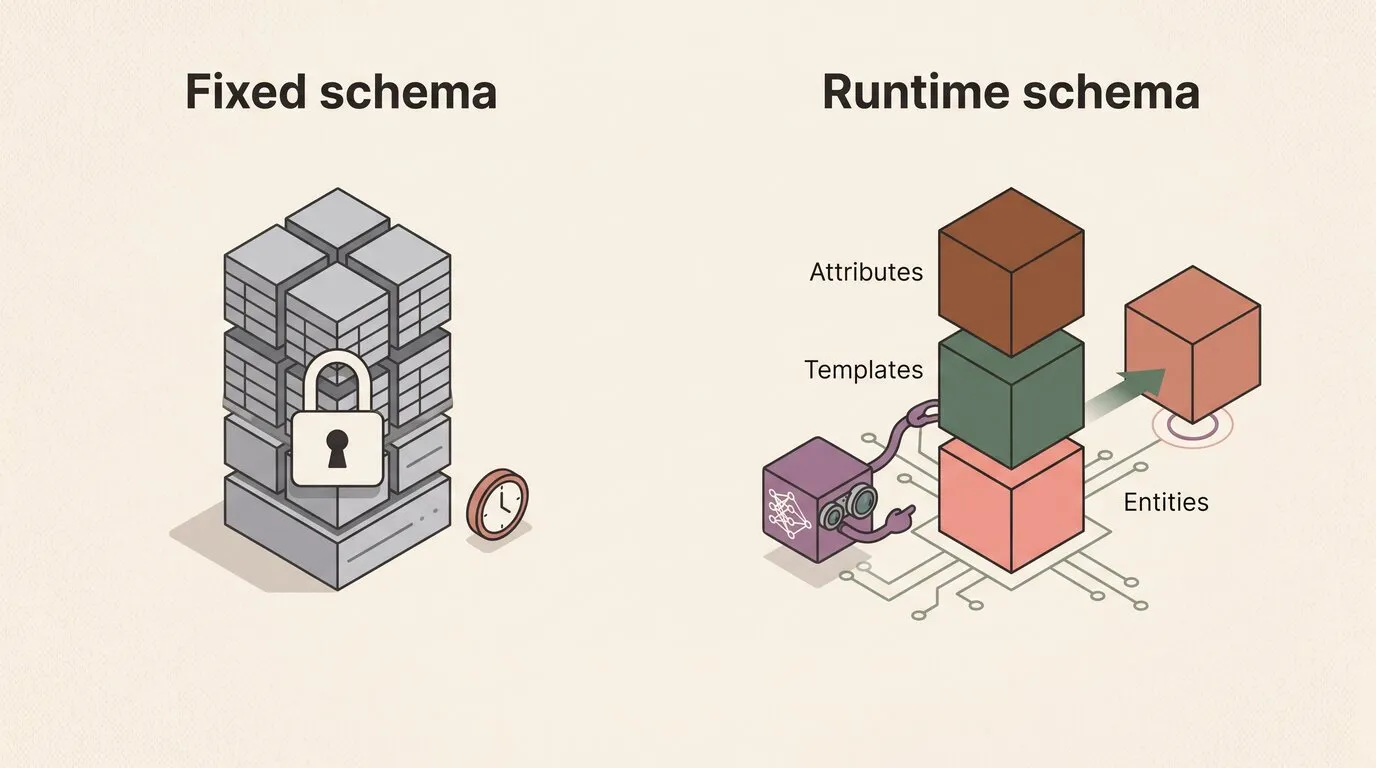
Autonomous AI agents operating through the Model Context Protocol (MCP) are transitioning from isolated code assistants into operational executors and system builders. When an agent is tasked with setting up an operational system—such as establishing an IoT fleet workspace, adapting an infrastructure catalog, or tailoring a CRM pipeline—it requires persistent, structured storage.
Engineering teams attempting to pair autonomous agents with traditional relational backends encounter a fundamental mismatch. Traditional relational databases treat data structure as a compile-time deployment artifact.
When an agent needs to scaffold a new domain model, link operational entities, or establish custom metric streams, it collides with the friction of traditional software delivery: data definition language (DDL), schema migrations, ORM synchronization, and manual admin panel development.
The friction of traditional schema workflows for autonomous agents
Relational database management systems were designed around human-driven release cycles. In a standard production workflow, modifying database structure follows a deliberate sequence:
- A software engineer drafts migration scripts (
ALTER TABLE,ADD COLUMN,CREATE INDEX). - Pull requests undergo peer review and static analysis.
- Continuous integration pipelines run test suites against staging databases.
- Deployment tooling executes migrations during planned maintenance windows.
- Application code, Object-Relational Mapping (ORM) models, and API serializers are recompiled and redeployed to match the new database schema.
- Frontend engineers build or adjust user interface forms and data tables to expose the new fields.
This operational pipeline protects database stability when human developers make planned bi-weekly releases. But when an autonomous agent is instructed to create or extend an operational workflow, this pipeline creates an impasse.
Traditional Fixed-SQL Pipeline (Human Release Cycle):
Agent Tasked with Data Model → Draft SQL DDL & Migration Scripts → Git Branch & Pull Request → CI/CD Pipeline & Code Review → Apply Database Migrations → Recompile ORMs & CRUD Endpoints → Hand-Craft Admin UI → Operational Hours or Days Later
Omnismith Runtime Pipeline (Agent-Native Execution):
Agent Tasked with Data Model → Invoke MCP Tool (
scaffold_data_model) → Sub-Second API Mutation & Validation → Immediately Operational (Live Record Ingestion, Audit Ledger & Auto-Generated Master-Detail UI)
If an agent is asked to “create a cold-chain monitoring system with temperature metrics and assigned drivers,” forcing it to generate migration files, open a pull request, wait for pipeline checks, redeploy application containers, and manually construct frontend screens defeats the entire purpose of autonomous execution. The human operator expects a functioning operational workspace in seconds, not a multi-day development ticket.
Why delegating direct DDL to agents is an anti-pattern
Attempting to bypass human release cycles by giving autonomous agents direct database credentials to execute raw DDL (CREATE TABLE, ALTER TABLE) creates unacceptable operational and security hazards:
1. Excessive privilege footprints & prompt injection risks
Executing DDL statements requires elevated database administrative rights. Granting an autonomous LLM execution path direct DDL privileges violates the principle of least privilege. A prompt injection attack, context confusion, or hallucination could execute destructive operations (DROP TABLE, column truncations, or corrupted cascading deletes) with zero application-level guardrails.
2. Dialect fragility and migration failure
LLMs frequently struggle with database-specific DDL syntax nuances, dialect variations (PostgreSQL vs. MySQL vs. SQLite), transaction semantics, and indexing rules. A syntax error during a complex table alteration risks leaving database state inconsistent, requiring manual human database administrator intervention.
3. Separation of schema from application capabilities
Even if an agent successfully executes a CREATE TABLE statement, the raw database table remains completely disconnected from the rest of the application stack. There is no automatic API endpoint, no typed validation logic, no role-based permission scoping, no field-level audit trail, and no user interface for human operators to inspect or edit records. The agent has merely created an isolated database table, not an operational system.
The limitations of unstructured JSON storage
To bypass the rigidity of SQL migrations and deployment pipelines, many engineering teams turn to document databases or dump dynamic fields into an unstructured metadata JSONB column inside a relational table.
While schemaless columns accept arbitrary fields without migrations, this approach introduces severe engineering debt:
- Validation erosion: Schemaless JSON payloads lack compile-time type validation. One agent writes
"battery_level": 94.2, while another writes"battery": "94%". Over time, data quality degrades without schema enforcement. - Loss of referential constraints: Foreign references between operational entities become opaque strings inside JSON trees. The database engine cannot enforce referential integrity, detect orphaned references, or cascade deletions.
- Telemetry breakdown: High-frequency time-series observations trapped in JSON blobs cannot leverage optimized time-series aggregation, downsampling rollups, or instant chart streaming.
- Operational opacity for human teams: Schemaless blobs hide information behind nested key paths. Human operators lose filterable data grids, standardized edit forms, and structured dashboards.
- Diluted audit trails: Updates to JSON blobs overwrite large document segments, obscuring field-level audit history and complicating regulatory compliance.
How runtime schemas treat data models as API data
Omnismith resolves this dilemma by treating data schemas as typed runtime data managed through standard REST endpoints and Model Context Protocol (MCP) tools.
The system models operational domains through dynamic primitives — typed runtime constructs declared and evolved via standard API calls:
- Attributes: Individual typed data fields (
dimension,metric,list,reference). - Templates: Structured schemas that group reusable attributes into distinct operational models (such as
Server Node,Cold-Chain Truck, orClient Account). - Entities: Concrete data records instantiated against an active template.
- Workspace views: Filtered, sorted lenses that display entities in configurable table or card grid layouts.
Template Definition: Edge Node (
edge_node)
- Hostname:
dimension(text)- Status:
list(Active,Offline)- CPU Load:
metric(time-series telemetry)- Assigned Facility:
reference(links to targetFacilitytemplate)↓ Instantiates concrete operational records
Entity Record:
edge-fra-01
- Hostname:
edge-fra-01.infra.internal- Status:
Active- CPU Load:
42.8%(streams directly to the time-series engine)- Assigned Facility: →
Frankfurt Data Center- Audit Ledger: All attribute mutations immutably logged with actor attribution and timestamps
When an agent needs to evolve a schema, it executes a standard HTTP request or MCP tool call. The platform registers the new attribute, links it to the template, and makes it available for immediate reads and writes across the entire workspace in milliseconds.
The operation executes with zero DDL execution, zero migration scripts, and zero service restarts.
Eliminating lookup latency with universal project slugs
Autonomous agent loops encounter high latency and token overhead when forced to track and resolve opaque database identifiers across multiple pre-flight requests.
Omnismith eliminates this friction through universal project-unique string slugs:
- Deterministic handles: Attributes, templates, and entities declare clean, readable slugs (such as
temperature_celsius,coolant_pressure, andedge_node). - Direct write capability: An agent sends structured payloads directly using string slugs without querying the database for primary keys first.
- Optimized query resolution: Entity endpoints accept
?attribute_key=slugto return data mapped directly to human-readable keys, minimizing the token context required for subsequent reasoning steps.
# Direct entity creation via human-readable slugs
curl -X POST "https://api.omnismith.io/v1/entities/template/edge_node" \
  -H "Authorization: Bearer omni_live_secret_key_..." \
  -H "X-Omnismith-Project-Id: $PROJECT_ID" \
  -H "Content-Type: application/json" \
  -d '{
    "attributes": {
      "hostname": "edge-fra-01",
      "firmware_version": "v2.4.1",
      "operational_status": "Active"
    }
  }'
Immediate platform inheritance for new attributes
The critical advantage of runtime typed schemas over schemaless JSON document stores is platform inheritance. The moment an agent registers a new attribute or template, that field inherits full enterprise platform capabilities:
Native time-series telemetry engine
When an attribute is declared with attribute_type: metric, the system registers it directly with the high-throughput time-series engine. The agent or external hardware sensors can stream timestamped observations immediately via POST /v1/entities/{id}/metrics. The platform manages retention, continuous rollups, downsampling, and sub-second sparkline rendering automatically.
Append-only audit ledger
Every state modification applied to an entity attribute writes an immutable log entry to the audit ledger. The platform captures the cryptographic author attribution (identifying whether a human user or an MCP-connected agent executed the change), the exact timestamp, the previous value, and the new value. Regulatory compliance and traceability are guaranteed out of the box.
Granular RBAC and row-level access control
New attributes and templates immediately respect project-level role-based access controls and granular row-level access scopes. Security boundaries remain strictly enforced, preventing unauthorized agent read or write access across tenant workspaces.
Instant operational web interfaces
When an agent builds a data model, human team members do not need to wait for a frontend engineering team to construct an admin panel. The Omnismith web application generates typed 2-column detail layouts, dropdown choice pills, relationship links, and filterable table views instantly.
| General Information | Hardware Telemetry |
|---|---|
Hostname: edge-fra-01.infra.internal | Ambient Temperature: 24.5 °C (live sparkline) |
Firmware Version: v2.4.1 | CPU Load: 42.8% (live sparkline) |
Operational Status: [ Active ] (choice pill) | Assigned Facility: Frankfurt DC (foreign reference link) |
Scaffolding an operational model through MCP tool calling
In practice, an agent connected to Omnismith via the Model Context Protocol uses composite orchestration tools to scaffold complete, relational business systems in a single turn.
Consider an autonomous agent instructed by an operations director:
“Set up an IoT monitoring workspace for cold-chain delivery vans. Track van ID, operational status, cargo temperature, and battery voltage. Link each van to an assigned driver.”
The agent calls the composite scaffold_data_model tool:
{
  "templateName": "Cold-Chain Van",
  "templateSlug": "cold_chain_van",
  "templateDescription": "Refrigerated transport fleet assets equipped with telemetry sensors",
  "templateCategory": "Fleet Logistics",
  "attributes": [
    {
      "name": "Van Identifier",
      "slug": "van_id",
      "type": "text",
      "description": "Unique vehicle identification number"
    },
    {
      "name": "Operational Status",
      "slug": "status",
      "type": "list",
      "description": "Current logistics state",
      "listOptions": ["In Transit", "Staging Depot", "Maintenance"],
      "defaultValue": "Staging Depot"
    },
    {
      "name": "Cargo Temperature",
      "slug": "cargo_temp",
      "type": "metric",
      "description": "Internal compartment temperature in degrees Celsius"
    },
    {
      "name": "Battery Voltage",
      "slug": "battery_voltage",
      "type": "metric",
      "description": "Vehicle auxiliary battery voltage"
    },
    {
      "name": "Assigned Driver",
      "slug": "assigned_driver",
      "type": "reference",
      "referenceTargetTemplate": "driver_profile",
      "referenceTargetAttribute": "driver_name"
    }
  ],
  "groups": [
    {
      "name": "Vehicle Details",
      "columns": 2,
      "attributeNames": ["Van Identifier", "Operational Status", "Assigned Driver"]
    },
    {
      "name": "Live Environmental Telemetry",
      "columns": 2,
      "attributeNames": ["Cargo Temperature", "Battery Voltage"]
    }
  ]
}
What happens during this single tool call
- Discovery and reuse: The tool scans existing project attributes, reusing shared fields to maintain platform-wide consistency.
- Type mapping: Attributes are mapped to concrete storage types.
cargo_tempis registered directly with the high-throughput time-series engine. - List configuration: Choice options (
In Transit,Staging Depot,Maintenance) are assigned stable identifiers and validation rules. - Reference resolution: The reference link connects foreign records between the
Cold-Chain VanandDriver Profiletemplates. - Atomic rollback protection: If an invalid reference target is encountered, the tool rolls back all created attributes automatically, leaving clean project state.
Upon completion, the agent immediately populates the system with real records using create_entity:
{
  "template": "cold_chain_van",
  "attributes": {
    "van_id": "VAN-8492",
    "status": "In Transit",
    "assigned_driver": "019fb43e-de74-7149-a92d-5448f16001bc"
  }
}
And streams time-series telemetry to POST /v1/entities/{id}/metrics:
{
  "metric_values": [
    {
      "attribute_slug": "cargo_temp",
      "value": "-18.4",
      "updated_at": "2026-09-10T14:30:00Z"
    },
    {
      "attribute_slug": "battery_voltage",
      "value": "13.8",
      "updated_at": "2026-09-10T14:30:00Z"
    }
  ]
}
The entire system of record—including relational links, live time-series charts, and human administration screens—is fully operational in under eight seconds.
Structural comparison across schema paradigms
| Capability | Fixed SQL Schema (DDL) | Schemaless Document (JSON) | Omnismith Runtime Schema |
|---|---|---|---|
| Model Scaffolding Latency | Hours to days (PR, CI/CD, deploy) | Zero (Unchecked ad-hoc writes) | Sub-second API / MCP mutation |
| Full-Stack Delivery Overhead | High (Write ORMs, APIs, UI forms) | High (Manual frontend & validation) | Zero (Instant platform inheritance) |
| Agent Security Boundary | High Risk (Requires raw DDL rights) | Standard application rights | Scoped application / MCP rights |
| Data Type Enforcement | Strict database-level types | None (Vulnerable to drift) | Strict runtime API validation |
| Relational Integrity | Enforced via SQL foreign keys | Broken (Opaque JSON references) | First-class dynamic references |
| Time-Series Telemetry | Requires dedicated tables/engines | Inefficient for high frequencies | High-throughput streaming engine |
| Audit Ledger Quality | Requires custom triggers & tables | Low (Coarse document diffs) | Append-only granular field ledger |
| Human Interface Generation | Requires custom UI engineering | Minimal or raw JSON viewers | Auto-generated responsive layouts |
The agent-native backend thesis
Building systems for autonomous agents requires re-evaluating core architectural assumptions. Forcing software agents through human software delivery cycles—generating migration files, waiting for deployment pipelines, and manually hand-crafting admin interfaces—defeats their primary advantage: rapid, autonomous execution.
Conversely, removing schema structure entirely by relying on unvalidated JSON blobs produces unmaintainable software that fails basic operational, relational, and compliance requirements.
Runtime typed schemas provide the missing foundation. Agents gain the autonomy to scaffold, adapt, and populate the exact backend models they require in real time through standard MCP tools. Meanwhile, human operators retain typed validation, cryptographic audit trails, role-based security, and auto-generated operational interfaces.
This thesis extends the same schema-flexibility case made in Why Omnismith Uses Flexible Schema for Operational Data, applied specifically to agent-driven workloads, and pairs with the tool-calling mechanics covered in AI Tool-Calling: Translating Business Requirements to Database Schemas.
To connect your AI agents to an agent-native backend, explore our Model Context Protocol guide or inspect the Headless Backend documentation.